
Two Parties, Two (Different) Problems
And why we have to pry the two-party system open.

An old friend asked me a few weeks ago if the strategy we are pursuing holds up in the current crisis. It was a friendly, serious question. He knows that organizers have to stay focused if they are to get anything done, but sometimes they (we) can get locked in on a strategy even as circumstances have changed.
The question crystallized thusly: “Is the effort to move from a two-party system to a multi-party system still relevant in the age of Trump? Isn’t the more crucial need the emergence of national candidates capable of inspiring the citizenry to abandon and/or defeat authoritarianism?
The easy answer is to say we need both. But begging your indulgence, let’s try for something a bit more rigorous.
Consider the party in power. Neither President Trump nor Congressional Republicans are especially popular with the broad voting public. Trump’s job approval rating has slumped to 37%, slightly above his all-time lowest rating of 34%. Trump’s “One Big Beautiful Bill” is an albatross around the necks of the GOP Members of Congress, and they know it. (They are trying to retroactively change the name of the bill to something less subject to derision).
Consider the opposition party. As you probably know, the only number worse than Trump’s is the Democratic Party’s standing with the public: 33% favorability. Journalists, party operatives, intellectuals, organizers and elected officials have taken to Substack, opinion pages, private meetings, press conferences and the streets to speak in opposition, offering the Democrats all kinds of approaches, but the messaging is all over the place and the citizenry is not buying what they are selling.
In sum, a portion of Trump’s policies are manifestly unpopular. Yet the Democratic party is not benefiting from his nosedive (in part because their own agenda receives a mixed reception).
There’s a well-known explanation for this contradictory situation:
Trump and the GOP are plowing ahead despite his dropping poll numbers because a core MAGA base remains unshakeably loyal; and
Democrats do poorly in public opinion surveys because their base is angry and frustrated with them, and voters in the middle are mixed on the party’s message.
Both of these trends are largely true and likely to continue. The question is why? A deeper look takes you to the rules of the electoral game and the ways in which those rules themselves influence and structure the public’s loyalties and opinions.
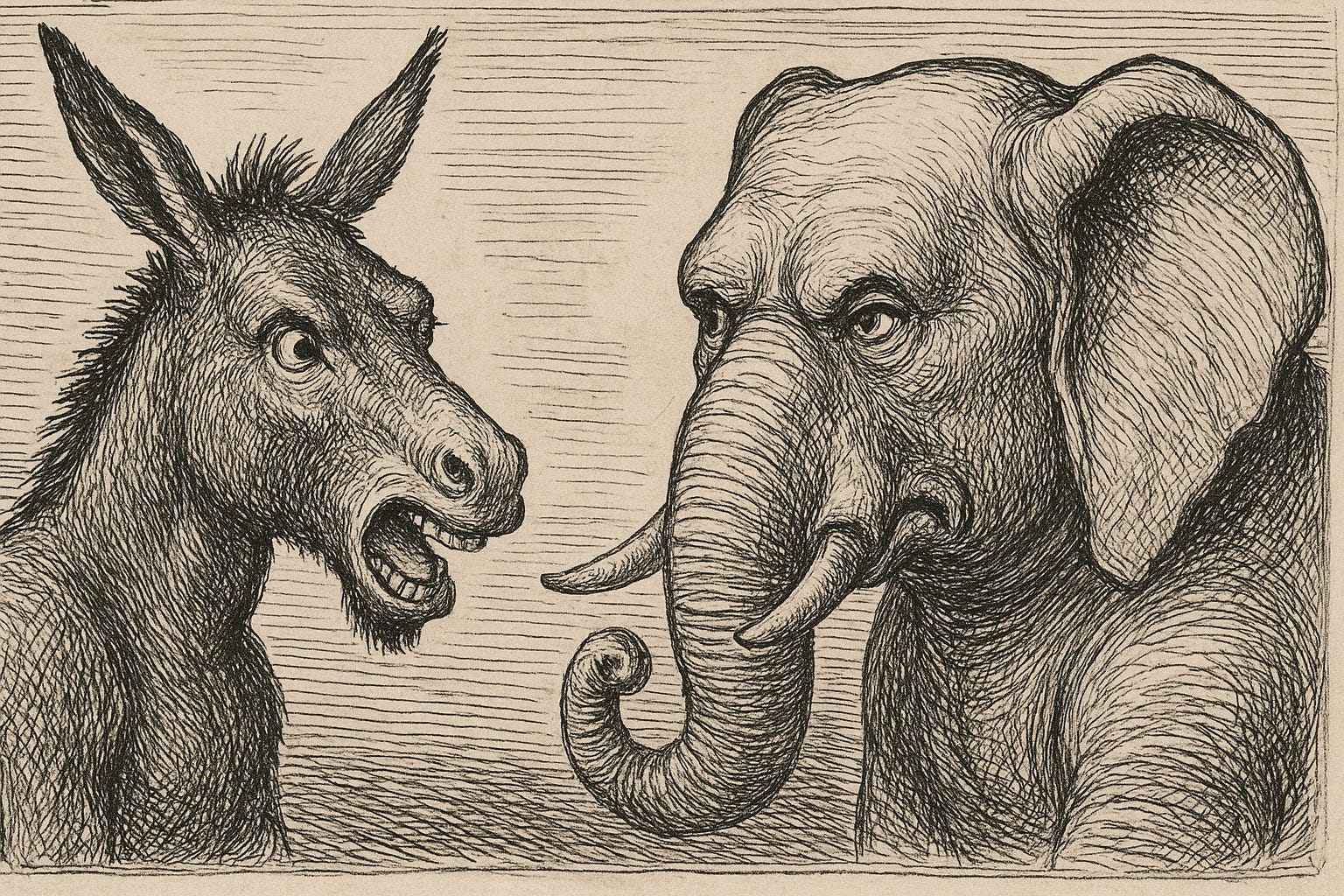
The heart of the matter is no mystery. It’s the system, meaning the zero-sum, winner-takes-all, two-party system.
If the goal of government is to solve public problems, and if you live in a pluralist society in which not everyone agrees on the way to do so (or even what constitutes a problem), then you should really favor a system that incentivizes meaningful representation of the citizenry’s views via party coalitions, principled bargaining and compromise.
We have more or less the opposite of that. A pre-modern, zero-sum system in which representation is hit-or-miss, party coalitions are non-existent, bargaining is for weaklings and compromise is for losers. The alternative – a modern, positive-sum, more proportionate system that favors progress for all over a world of winners and losers – is simply not achievable under the “winner takes all” system that characterizes American politics today.
Problem #1: Factional Takeover of One Party!
According to YouGov, 15-20% of all Americans identify as supporters of MAGA. Let’s use the higher number – one in five Americans is a hard-core, pro-MAGA voter, fully entitled to their opinions. That’s a non-trivial share of the population, but it's far from a majority.
But this non-trivial faction has the good fortune to live in a two-party country, because only in our system can 20% of overall voting strength be converted into 100% control of a party. Is it a magic trick? Not at all. Those MAGA voters may only be 20% of America, but they are a solid 60%-plus majority of the GOP. The Republican Party has been taken over, legally and appropriately, by its major faction.
Competing factions remain, but they are weak. Less than one-fifth of Republican voters self-identify as moderates. Smaller still is the GOP’s principled libertarian faction. As long as the MAGA base stays loyal to Trump, there’s no reason for him to change course. Even the non-MAGA voter in the GOP can be persuaded to stay loyal because, well, where would they go? “The other side is worse” is a powerful argument.
It’s safe to say that our two-party system, which almost all of the world’s democracies are smart enough not to emulate, has serious design flaws. It allows a party that controls the White House and Congress to govern in an unrestrained, anti-democratic manner if the requisite will to power exists. There are, it turns out, few checks and not many balances if a nation’s party system is of the winner-take-all variety. Traditions and norms are little match for a disciplined faction that disdains compromise and threatens primaries and social media hell on any renegades who think otherwise.
Problem #2: Factional Incompatibility in the Other Party!
On the other hand, if no single faction is strong enough to dominate its party, the result can be incoherence. This is another challenge inherent to the two-party system, and right now it’s the one hobbling the Democrats.
Like the GOP, the Democratic party has factions that contest for control, but the Democratic coalition is far more diverse and fractious than the Republican one. So that makes it much harder to get agreement on a unified, coherent vision.
Alexandra Ocasio-Cortez put it this way back in early 2020: “In any other country, Joe Biden and I would not be in the same party, but in America, we are.”
She was right. Indeed, in most European democracies, which use various forms of proportional representation, a politician like Biden would be at home inside a socially liberal, fiscally moderate party like the German Social Democratic party. AOC would more likely be part of the German Green Party. The two parties would sometimes be in a governing coalition with each other – bargaining with each other over policy. The party with the more attractive vision and higher vote share would naturally exercise a higher share of governing power, but everyone gets something and everyone will battle it out again at the next election. It’s a system with party competition in elections and party coalitions in government.
Democrats don’t have a unified vision and rely instead on being “not Trump.” This will not be enough. The whole point of a political party is to develop and promote an affirmative, inspiring vision. The decades-long fight between the Democratic center and left is evidence of this underlying disunity. So it’s little wonder that today’s Democrats are losing ground even with their own voters — the party is riven by too many factions for it to present a unified, compelling face to the public. And in today’s information environment, where every day we all compete for attention, the lack of a clear message translates into no message at all.
In a multi-party system, there is still plenty of competition for the citizenry's attention. Competition is healthy; parties test themselves in the political marketplace by drawing distinctions. But when push comes to shove, the incentives also drive like-minded parties into alignment, which is also healthy. In France last year, various centrist and left-leaning parties came to rapid (if temporary) agreement to stop an authoritarian takeover of the national legislature. And in 2023, perhaps more dramatically, Poland saw the formation of a three-party coalition that proved popular enough with voters to dislodge a deeply authoritarian right from power (again, at least temporarily).
The History, and…
Our contention is that the legalization of fusion voting and fusion parties could help solve both problems: the disinhibited faction on the one hand, and the incoherent faction on the other.
Fusion – for the uninitiated – is a form of multi-party democracy that was once the norm across America. One might think of it as proportional representation in single-winner elections, in that the election results show the proportionate shares that various parties “deliver” to a joint, fusion candidate.
Throughout the 1800s, the two major parties – first the Democrats and the Whigs, and then after the Civil War the Democrats and the Republicans – shared the political stage with a host of smaller parties. These challengers, which are remembered under names like the anti-slavery Liberty Party, the Free-Soil Party, the anti-Nebraska Party, the Greenback Party, the Prohibition Party and the People’s Party, all took advantage of a more fluid electoral system. Parties printed and distributed their own ballots, which meant smaller parties could cross-nominate (or fuse with) major party candidates without giving up their independence. Such alliances, or fusions, helped elect many anti-slavery candidates in the late 1840s and 1850s, and later in the 1880s and 1890s, they propelled populists into office in Congress and many statehouses.
The two dominant parties did not like the fusion system, to put it mildly, and at the turn of the last century, it was banned state by state. Today, fusion parties with distinct ballot lines exist in two states – Connecticut and New York. In both, third parties on the left, right and center have played a meaningful and constructive role in politics for many decades.
…the Potential
Which brings us to the promise of the current moment. There is action right now that could shake things up in a productive, even powerful way. In three states, New Jersey, Kansas and Wisconsin, citizens are trying to pry the two-party system open, and there are leaders and voters in at least another half-dozen states who want to bring copycat litigation early next year. In all cases, these suits seek to overturn existing state-level fusion bans as an unconstitutional abridgement of the right to free association under the respective state constitution (No way should we go into federal court). The plaintiffs are, respectively, the New Jersey Moderate, United Kansas, and United Wisconsin parties. These proto-parties include dismayed but not discouraged Republicans, Democrats and unaffiliated voters, all of whom believe that a fusion party which cross-nominates pro rule-of law moderate candidates will do well with voters.
Are they right to argue that fusion parties might get us out of the two-party straitjacket? Nobody knows for sure how a multi-party system would play out in 21st century America. But we can say with confidence that the current system isn’t working, we have to do something different, and we know that democracy in America worked better when it was more pluralist.
That friend wasn’t wrong: good national candidates who embody the popular desire for freedom and democracy are crucial. But he wasn’t quite right, either. Better than a singular savior is a set of institutional structures and rules that incentivize the emergence of fusion parties anchored in civil society organizations.
At the end of the day (and some days it does feel like things are ending!), we need more and better parties nested in a system that encourages and rewards coalition and compromise. Without something close to that, the government will continue to fail because politics will continue to fail. Alienation and cynicism and even violence will overwhelm the “let’s make steady progress” brigade (of which everyone reading this is by definition a member). So let’s get the incentives right, and if you know any state Supreme Court justices, feel free to get them a subscription to The Ticket!
Reading / Watching / Listening
Writing in the New Jersey Monitor, Rayman Solomon, Robert Williams, and John Farmer – a “dream team” of Garden State legal eminences -- weigh in on the NJ Moderate Party’s pending appeal of the state’s fusion ban, urging the State Supreme Court to take up the case. As they say, “At a time when democracy is being eroded throughout our country, the court has the opportunity to reaffirm the New Jersey Constitution’s strong commitment to freedom of association and voter choice — both bedrocks of democracy.”
Ian Bassin of Protect Democracy on how he vacillates between being a Star Wars and Lord of the Rings person, but relies on Tolkien's philosophy of “The Long Defeat” to cope with current times.
Back in the spring, I gave a TEDx talk in Adams-Morgan about the “The Revival of Fusion Voting.” Check it out!
United Wisconsin Party - Their latest newsletter on developments in the Badger State. Smart and focused grassroots political organizing.
Why is this newsletter called The Ticket? The name comes from the phrase “vote the ticket,” which is what political parties urged their supporters to do in the 1800s, when fusion was legal and widely practiced (see here if you don’t know how fusion voting works). Parties printed their own ballots or published them in newspapers that they were aligned with. Then they exhorted their supporters to “vote the ticket” by dropping that ballot or page from the newspaper into the ballot box on Election Day. All such ballots were legitimate, and "fusion" coalitions between major and minor parties were commonplace from Abolition to the turn of the 20th century. But Jim Crow Democrats (in the South) and Gilded Age Republicans (in the North and West) eventually tired of the challenge and disruption that third parties represented, and in state after state fusion voting was outlawed (and coalitions between parties disappeared). But what was banned can be unbanned.
Please forward this to anyone you know who loves their country.
Learn more on fusion voting and multi-party democracy at the Center for Ballot Freedom.
Great TedTalk Dan! How do we do it in Maine?
Steve Hindy